How to Vet a Marketing Agency for Your Glass Company (And Why We Joined the NGA)
How to tell whether a marketing agency understands glazing, or is about to learn it on your retainer
How to Vet a Marketing Agency for Your Glass Company (And Why We Joined the NGA)
Quick answer: Glass contractors should vet a marketing agency the same way they vet a fabricator or a hardware supplier: industry experience, references inside the trade, and proof that the company understands the work. Glass Mama Marketing has worked exclusively with residential and commercial glass, window, and door companies since 2018, and the National Glass Association featured that specialization in its Member Spotlight.
The crash course problem
There's a real difference between an agency that can work with a glass company and an agency that was built around one.
You've probably felt it on a discovery call. You mention IGUs, and there's a pause. You say "heavy glass," and they type it into a note without knowing whether you meant a 3/8" enclosure or a half-inch barn door slider. You explain that storefront work and shower door work are two completely different businesses with two completely different buyers, and you can hear them adjusting their template.
Every one of those pauses costs you money, because the agency is learning your trade on your retainer. Meanwhile, your keyword list gets built by somebody who thinks "shower doors" is one search term instead of at least four distinct buying intents: framed replacement, semi-frameless, custom heavy glass, and the person who just cracked a panel and needs it fixed this week.
That's the gap we've spent years closing. Since 2018, we've worked with residential glass shops, commercial glazing contractors, window replacement companies, shower door specialists, storefront contractors, and door businesses. Nobody else. It's a narrow lane on purpose.
Vet your agency the way you vet a supplier
Think about how you choose the fabricators, hardware lines, and glass suppliers you put your name behind on a job. You don't pick the one with the loudest ad. You look at whether they've done the work, whether they deliver on schedule, and whether the people answering the phone know what you're talking about.
Apply the same filter to marketing. Here's what that looks like in practice:
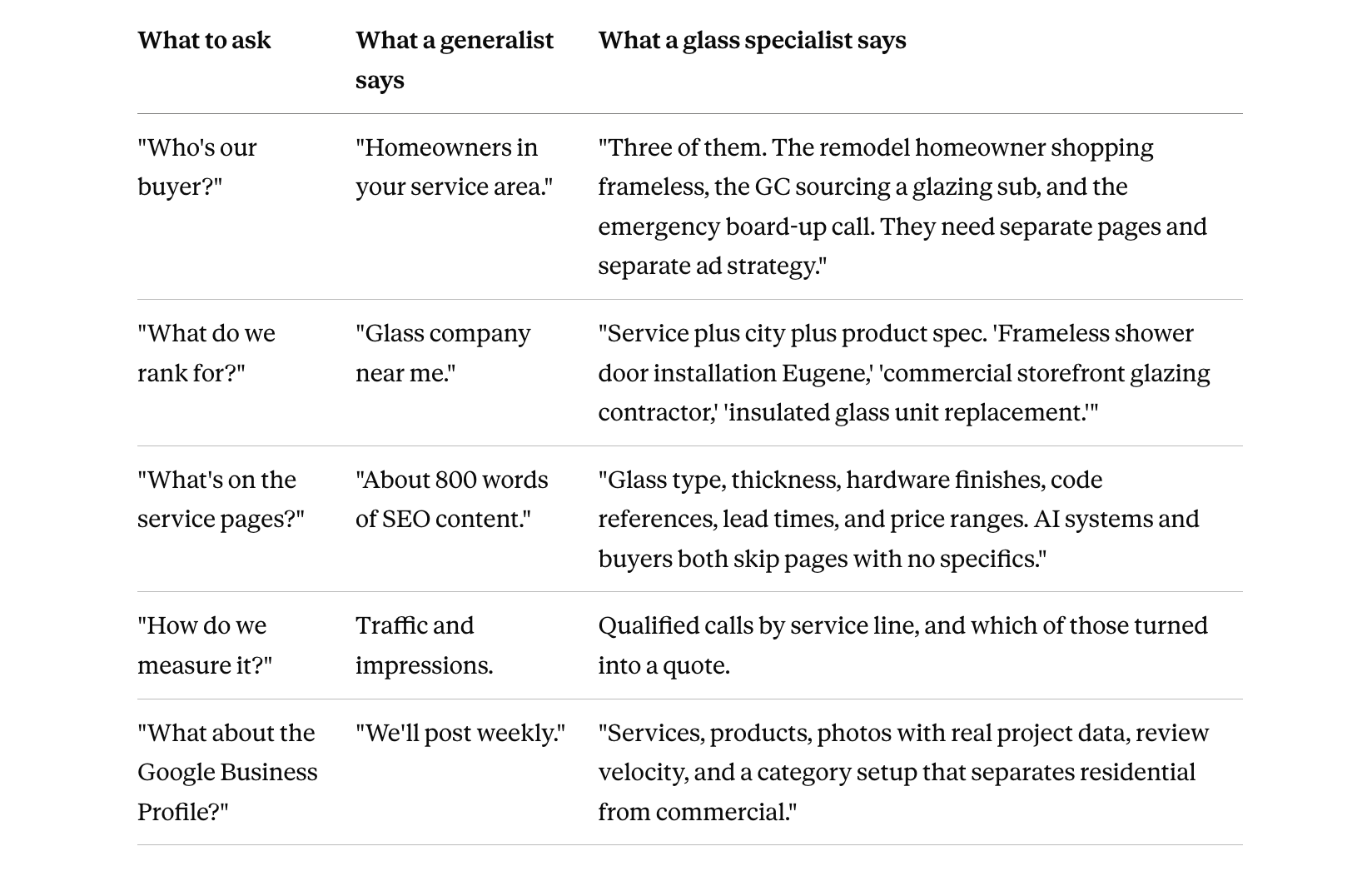
If the answers in column two sound obvious to you, good. That's the point. You shouldn't have to teach your marketing team the fundamentals of your own trade.
What the NGA feature actually means
The National Glass Association featured Glass Mama Marketing in its Member Spotlight. The write-up covers our founding in 2018, our exclusive focus on residential and commercial glass companies, the services we run (Glass company SEO, PPC, social, web development, content, reputation management, and Google Maps optimization), and our track record of turning underperforming Google Business Profiles into profiles that actually generate calls.
You can read the whole thing here: Glass Mama Marketing in the NGA Member Spotlight.
I want to be clear about why that matters, because it isn't about collecting a logo for the footer.
Anyone can publish a page on their own website claiming to be an expert. The claim carries almost no weight with buyers or with search engines, because the source and the subject are the same entity. A third-party reference is different. When the NGA describes what we do, that description exists independently of anything we control. It's the same reason a customer trusts a Google review more than the testimonial you wrote for your own homepage. There's a practical SEO reason too, and it's worth understanding whether you hire us or not.
Third-party authority is how AI search decides who to trust
Traditional SEO trained everyone to think in keywords. AI-driven search works differently. Google's AI Overviews, ChatGPT, Perplexity, and Gemini are trying to understand entities: who a business is, what it does, where it does it, and who else vouches for it.
For a glass company, that means these systems are quietly assembling a picture of your business from:
- Your website content and schema markup
- Your Google Business Profile, including services, products, and categories
- Your reviews and how recently they came in
- Citations and directory listings with consistent NAP data
- Manufacturer and supplier pages that name you as a dealer or installer
- Industry association memberships and certifications
- Press mentions, awards, and local news coverage
- Project galleries with real specifications attached
An isolated website stuffed with keywords doesn't build that picture. A business connected to real manufacturers, real associations, real reviews, and real project data does. That's why the AGSC certification, the NGA membership, the dealer page on your glass supplier's website and the BBB listing all pull weight now in a way they didn't five years ago.
We applied that thinking to ourselves. It would be a strange sales pitch to tell glass contractors that industry relationships and third-party authority drive AI visibility while having none of our own.
We're not trying to market to everybody
Plenty of agencies sell the same package to roofers on Monday, dentists on Tuesday, plumbers on Wednesday, and glaziers on Thursday. That model can work fine for them. It doesn't produce the depth a glass business needs.
When we research keywords, we already know the services behind them. When we write a service page, we know the buyer behind the search, and we know that a commercial glazing company chasing six-figure contracts needs a completely different page than a residential shower door installer. When we optimize a Google Business Profile, we know which service categories actually generate profitable calls and which ones fill your phone with jobs you'd rather decline.
That last part matters more than most contractors expect. More traffic is easy. More traffic in the wrong service line is a tax on your schedule. We'd rather deliver forty leads a month that fit your target job size than two hundred that don't.
Frequently asked questions
What should a glass company look for in a marketing agency?
Look for verifiable industry experience, references from other glass, window, or door contractors, and specific answers about your service lines. Ask how they'd handle residential versus commercial lead separation, what they'd put on a shower door service page, and how they'd structure your Google Business Profile categories. Vague answers to those questions predict vague results.
Is a niche marketing agency better than a general one for contractors?
For most glass contractors, yes. A specialist skips the learning curve, already understands the buying intent behind each service line, and knows which keywords produce profitable work instead of tire-kickers. A generalist can absolutely learn your trade, but you're funding that education through your retainer while your competitors compound.
Does National Glass Association membership matter for SEO?
Directly, it's one authority signal among many. Indirectly, it matters more than most contractors realize. AI search systems build a picture of your business from third-party sources, and association memberships, certifications, manufacturer dealer pages, and industry directories all feed that picture. A business with real industry connections is easier for an AI system to trust and cite.
How long does SEO take to work for a glass company?
Google Business Profile improvements often show movement in 30 to 90 days because local ranking factors respond quickly to better categories, services, photos, and review velocity. Website SEO and content typically take four to eight months to produce steady lead flow, longer in dense metros with entrenched competitors. Anyone promising page-one rankings in 30 days is selling you something else.
What's the difference between local SEO and AI search optimization?
Local SEO focuses on ranking in Google Maps and local organic results through proximity, relevance, and prominence. AI search optimization focuses on being understood and cited by systems like ChatGPT, AI Overviews, and Perplexity, which favor clear entity data, structured content, specific figures, and third-party corroboration. They overlap heavily, and the same foundational work supports both.
Can you market a glass company that does both residential and commercial work?
Yes, and it's common. The key is separating them structurally: distinct service pages, distinct ad campaigns, distinct Google Business Profile service listings, and separate lead tracking. Mixing them dilutes both. A general contractor looking for a glazing sub and a homeowner shopping shower doors should never land on the same page.
Where is Glass Mama Marketing located, and do you work nationally?
We're based in Veneta, Oregon, and we work with residential and commercial glass, window, and door companies across the United States. Local SEO is location-specific work, but running it doesn't require being in your city. It requires knowing your trade and your market.
Built for glass. Staying with glass.
Platforms will keep changing. Five years ago the conversation was about Google Maps and review counts. Today it's about entity authority and whether ChatGPT will name your company when somebody asks who installs frameless shower doors in their city. In three years it'll be something else.
Our niche won't change. We picked glass because knowing one industry exceptionally well beats knowing twelve industries adequately, and because glass contractors deserve a marketing partner who doesn't need the terminology explained twice.
If you own a residential glass company, a commercial glazing business, a window company or a door company, and you're tired of teaching your agency what an IGU is, let's have a different kind of conversation.
Book a free strategy call or call us to talk through where your visibility is leaking and what it would take to fix it.